Fermented Red Yeast Rice - A Natural Ally
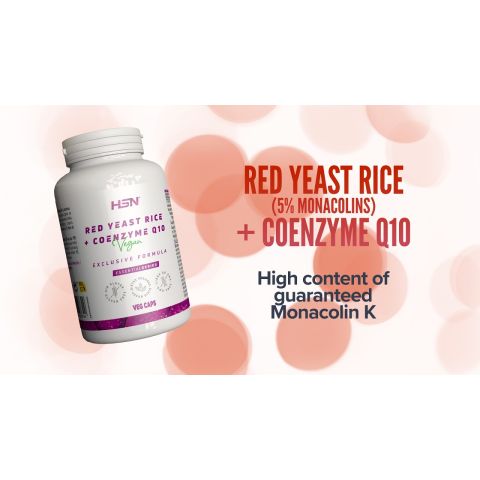
Red Yeast Rice (5% Monacolins) + Coenzyme Q10 from EssentialSeries is a high-concentration dietary supplement in veggie capsules that contains fermented red yeast rice powder (Monascus purpureus) standardized to 5% monacolins, with coenzyme Q10 in Ubiquinone form and B Vitamins (B1 + B12).
Red yeast rice is a traditional fermented product from China, containing monacolins, which are the most nutritionally interesting compounds in this development. Besides that, the fermentation of rice produces other types of compounds that might catch the interest of certain user groups, such as ergosterol, amino acids, flavonoids, alkaloids, sterols, isoflavones, amino acids, and monounsaturated fatty acids. The content of these compounds in our red yeast rice is unknown and varies between batches since the raw material has only been standardized for monacolin K.
Enjoy a practical, high-concentration, standardized, and quality product with HSN’s formula.
Get to Know Red Yeast Rice
Raw material standardized in monacolins and monacolin K
Depending on the yeast strain used for fermenting red yeast rice, it gets enriched with a variable variety and amount of natural compounds called monacolins.
Monacolins are all kinds of compounds extracted from the yeast Monascus purpureus.
Among them, monacolin K stands out, a specific subtype of monacolins, known for the extensive scientific research supporting it, to the point of receiving positive reports from the European Food Safety Authority about its beneficial properties:
EFSA Panel on Dietetic Products, Nutrition and Allergies (NDA); Scientific Opinion on the substantiation of health claims related to monacolin K from red yeast rice and maintenance of normal blood LDL-cholesterol concentrations (ID 1648, 1700) pursuant to Article 13(1) of Regulation (EC) No 1924/2006. EFSA Journal 2011;9(7):2304 [16 pp.]. doi:10.2903/j.efsa.2011.2304. Available online: www.efsa.europa.eu/efsajournal
HSN’s red yeast rice is standardized in monacolins and specifically in its monacolin K content, ensuring 3,75% of the raw material concentration is this valued compound with significant properties.
Production process of red yeast rice
Red yeast rice is a fermented product cultivated by inoculating fungi of the genus Monascus on cooked rice. This process causes the center of the rice grain to turn an intense red color while the outside pigments to a purple-reddish tone. The fermentation process lasts 3–6 days at room temperature.
The fully cultivated rice is processed to be sold dry, powdered (as is the case with the raw material used in this supplement), or cooked and pasteurized as a paste; mainly in Chinese markets, although it’s gaining more presence in the European Union.
During fermentation, despite the intense red tone it acquires (due to the natural production of red colorants - rubropunctamine and monascorubramine), it also develops pigments that naturally color the rice orange (rubropunctatin and monascorubrin) and yellow (monascin and ankaflavin).
Red yeast rice (also known as Beni-Koji in Japan) has been used for centuries in Eastern countries like China and Japan to add color, flavor, and preserve meats and fish.
Some current examples of red yeast rice use in food include making red rice vinegars, various types of tofu, Peking duck, traditional Chinese cakes and sweets, and red sakes.
Why are HSN’s fermentation control guarantees important?
Red yeast rice fermentation is a delicate process that requires great care to protect the microbiological safety of the raw material.
Do you know about mycotoxins?
They are toxins, as their name suggests, produced by fungal colonization in plants, for example, in European maize crops for food purposes, fungal contamination of ears is a concern for governments since it makes maize unfit for consumption if not controlled.
At HSN, we carefully control through analyses and strict monitoring of factors affecting fermentation (such as timing, media, temperature, light, and humidity) the development of red yeast rice to guarantee total absence of mycotoxins and ensure a completely clean and safe dietary supplement.
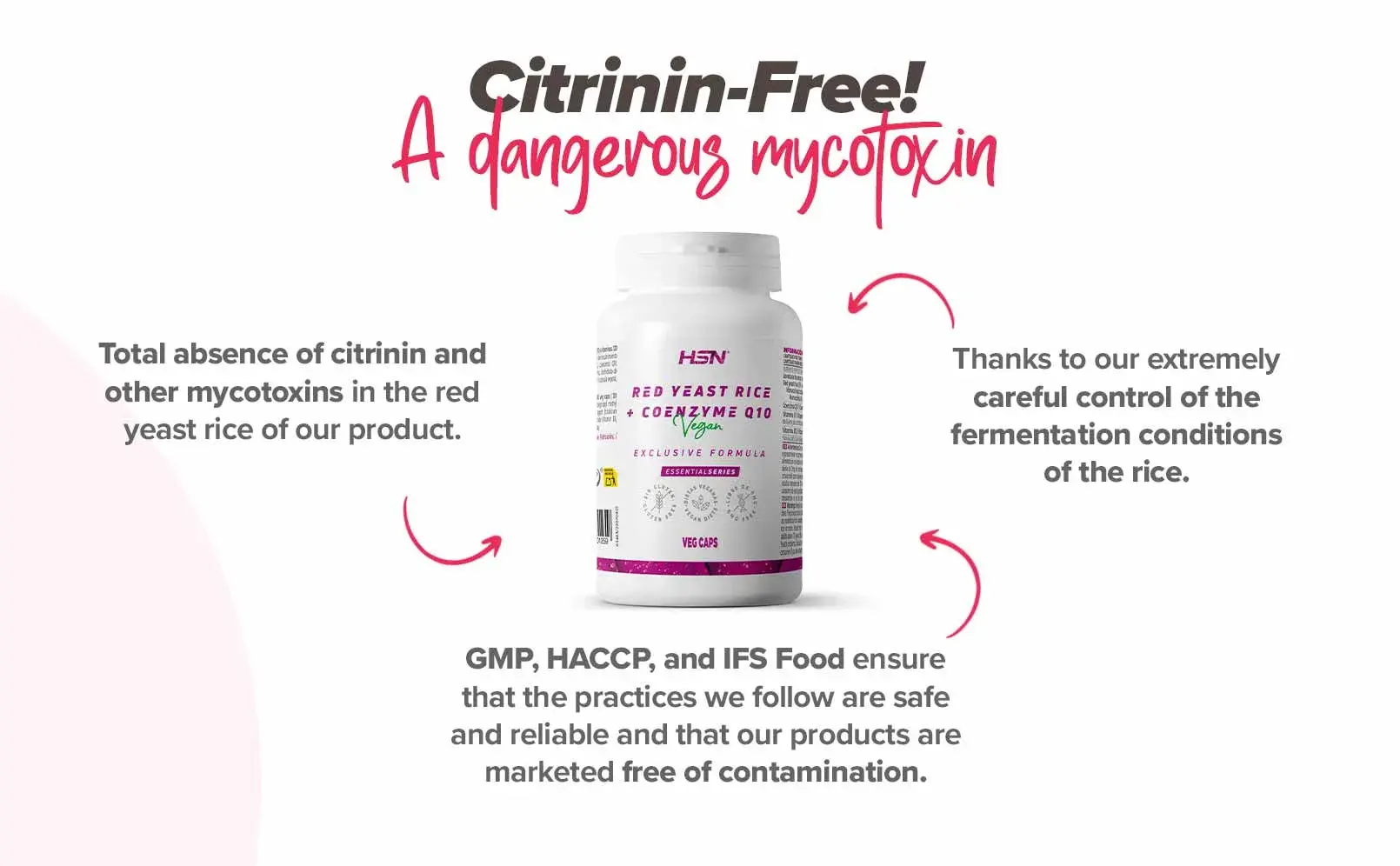
Citrinin, a dangerous mycotoxin. HSN certifies its absence
When talking about mycotoxins specifically in red yeast rice, citrinin is the most well-known type and the one that raises the most concerns since it’s a subtype naturally produced when this cereal is inoculated with this particular species (Monascus).
When using red yeast rice, it’s recommended to use ultra-concentrated raw materials (high purity) and quality certifications that back the production process to avoid citrinin formation.
Citrinin is a metabolite from Aspergillus and Penicillium species that can be linked to kidney and liver problems, contaminating red yeast rice during fermentation. Contamination can be avoided with proper fermentation control.
At HSN, we guarantee total absence of citrinin and other mycotoxins in the red yeast rice we sell, thanks to our extremely careful control of rice fermentation conditions, certified by internationally recognized external audit bodies such as GMP, HACCP, and IFS Food, ensuring our practices are safe, reliable, and our products are marketed free of contamination and with quality.
Check out our quality guarantees here.
Why add Coenzyme Q10 to the formula?
Coenzyme Q10 is an excellent complement to monacolin K’s action, as scientific studies recommend combined use of both compounds.
At HSN, you’ll find multiple Coenzyme Q10 supplements:
And its reduced form Ubiquinol:
But we wanted to provide a significant amount of this important compound within the red yeast rice veggie capsule formula, so each unit delivers 50 mg of pure coenzyme Q10.
To learn more about using Coenzyme Q10 combined with red yeast rice and its significance, we recommend checking this scientific study.
High-sensitivity analysis for monacolin K
Monacolin K is a delicate compound to handle, as improper industrial treatment of red yeast rice cultivation can fail to generate or degrade all natural monacolin content.
According to recent studies: some commercial red yeast rice products contain very little or no detectable monacolin K. However, others have been found to contain large amounts of monacolin K.
A 2017 review analyzed 28 brands of red yeast rice products from major US retailers, and none listed monacolin K amounts on the label. Two brands had no detectable monacolin K, and in the 26 brands that did, amounts varied over 60-fold, from 0,09 to 5,48 mg per 1.200 mg of red yeast rice.
You can read more about it here.
At first glance, it might seem good that some products analyzed contained more monacolin K than indicated, but this is just as bad as containing none, or even worse.
If a product contains more monacolin than indicated, it can be dangerous, either because the amount is too high or because the real impact isn’t considered when evaluating its use alongside a specific diet or other supplements.
This is where high-sensitivity analysis methods play a key role, and at HSN we know this and use these tools to ensure a stable standardized content across all production batches. Our red yeast rice is carefully analyzed to guarantee its content in every batch that leaves the factory and reaches your home.
No batches without monacolin K content or others with much higher amounts than indicated, at HSN we are transparent and trustworthy.
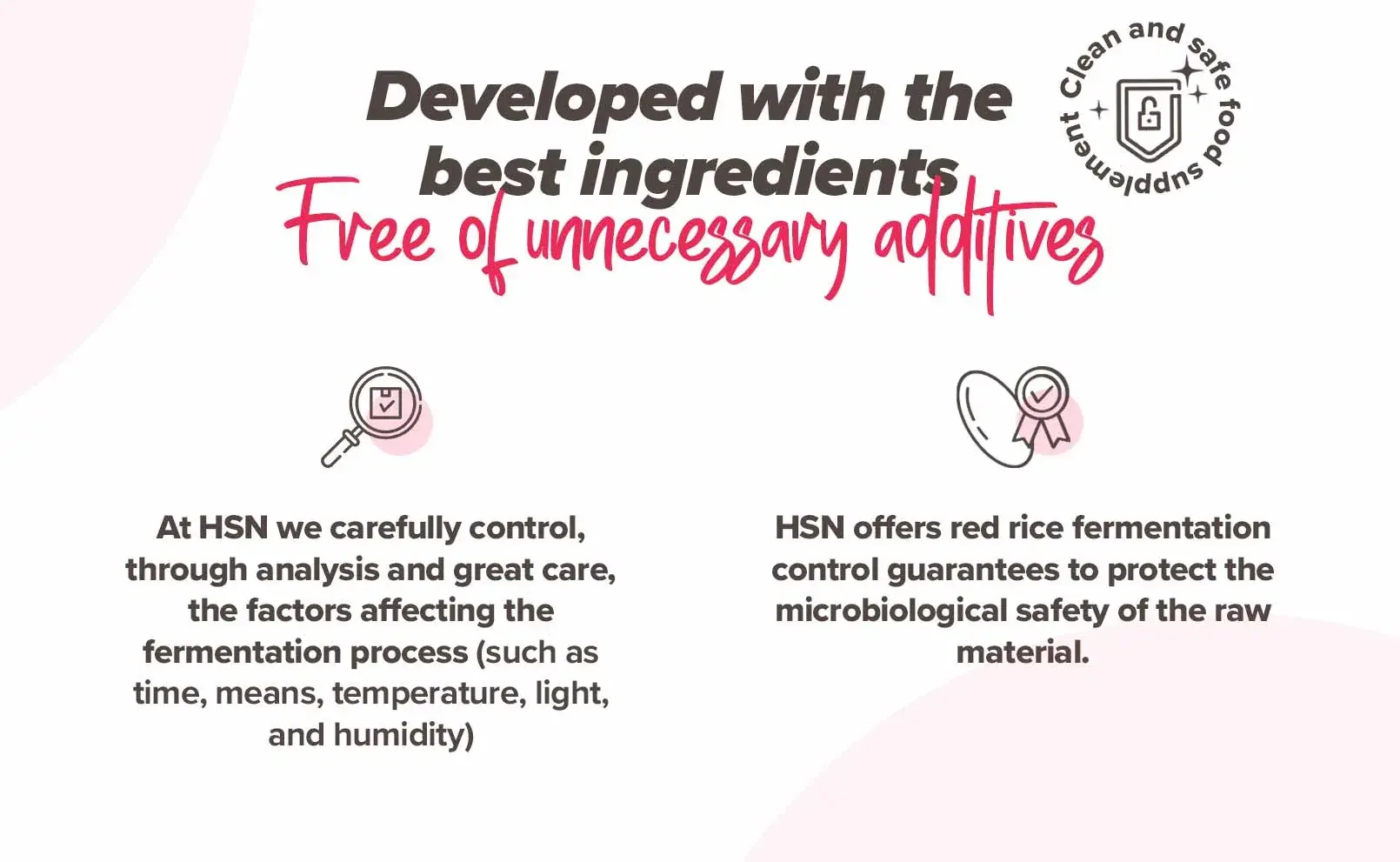
Free from unnecessary additives
At HSN, we have a clear idea:
We don’t want additives in our capsules and tablets unless absolutely necessary to keep the product in good condition with simple preservation (room temperature, closed bottle, away from sun and humidity, easy, right?). Additives help with this.
We use the smallest possible amount of additives, both in variety (number of different additives) and quantity per additive (how much of each additive). We use few additives and in small amounts, all completely safe, validated by safety reports from the European authority that authorizes their safe and studied use in human food.
Of course, we don’t add colorants to our capsules, we have nothing to hide, our veggie capsules are transparent, just like us.
Enjoy a more natural quality formula with HSN.
What can I combine it with for maximum effectiveness?
You can combine red yeast rice with all kinds of dietary supplements, as long as they don’t add extra monacolins, since using higher amounts should be discussed with your doctor.
But you can boost its properties by combining it with Fitosteroles Complex and Berberine + Silymarin. Find this product combo in the Pack - Control Your Cholesterol.
Take care with HSN products!
Bibliographic references
- de la Sierra, A., Pintó, X., Guijarro, C., Miranda, J. L., Callejo, D., Cuervo, J., … Rubio, M. (2015). Prevalence, Treatment, and Control of Hypercholesterolemia in High Cardiovascular Risk Patients: Evidences from a Systematic Literature Review in Spain. Advances in Therapy, 32(10), 944–961.
- EFSA Panel on Dietetic Products, N. and A. (NDA). (2010). Scientific Opinion on the substantiation of health claims related to coenzyme Q10 pursuant to Article 13(1) of Regulation (EC) No 1924/2006. EFSA Journal, 8(10), 1793.
- EFSA Panel on Dietetic Products, N. and A. (NDA). (2011). Scientific Opinion on the substantiation of health claims related to monacolin K from red yeast rice pursuant to Article 13(1) of Regulation (EC) No 1924/2006. EFSA Journal, 9(7), 2304.
- Marcoff, L., & Thompson, P. D. (2007). The Role of Coenzyme Q10 in Statin-Associated Myopathy: A Systematic Review. Journal of the American College of Cardiology, 49(23), 2231–2237.