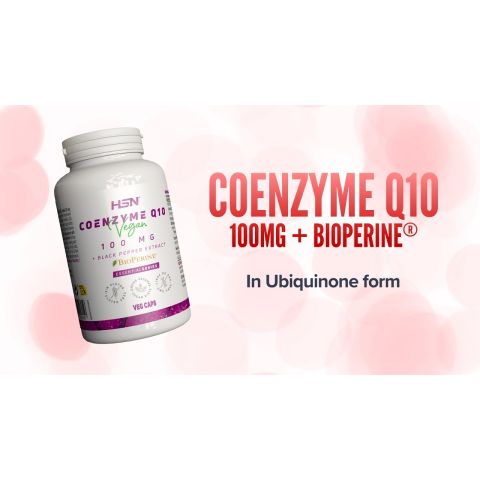
Coenzyme Q10 100mg + BioPerine® - Get to Know It
Coenzyme Q10 100mg + BioPerine® from EssentialSeries is a supplement in veggie capsules, made with coenzyme Q10 in ubiquinone form, black pepper extract standardized to 98.5% piperine (BioPerine®), vitamin B2 and L-selenomethionine.
Coenzyme Q10, also known as ubiquinone, is a molecule found in almost every cell of the human body. It’s most concentrated in tissues that need high energy levels, like the heart, kidneys, liver, and muscles. Although the body naturally produces it, production decreases with age (de Barcelos & Haas, 2019).
Coenzyme Q10 is a classic supplement in many people’s diets, especially those who don’t eat much red meat or offal.
Discover HSN’s Classic CoQ10 Formula
What is CoQ10?
Coenzyme Q10, or CoQ10, is a fat-soluble substance naturally found throughout the body. Its chemical structure is similar to vitamins, and because it’s widely distributed in tissues, it’s also called ubiquinone (from Latin 'ubique', meaning 'everywhere', and the suffix '-quinone', referring to its chemical structure, similar to quinones, a type of organic compound). The name 'ubiquinone' comes from its widespread presence in the body.
Even though the body synthesizes it on its own and can get some from the diet, many people, especially older adults, those using compounds that can block CoQ10 synthesis (like monacolin K or other statins), or those who eat little red meat; often add it as a dietary supplement.
Over time, natural CoQ10 production tends to decline. Studies on its presence during aging stages show that while it’s not a vitamin, since the body keeps producing it, it’s recognized as 'semi-essential'. Factors like age, oxidative stress, and certain conditions can affect its levels, making supplementation important.
100mg Dose: Standard
The 100mg ubiquinone dose in supplements is considered standard because studies show this amount offers an optimal balance between effectiveness and convenience.
This dose is enough to significantly raise CoQ10 levels, especially in people with low levels due to age or specific conditions, without risk of side effects. 100mg is established as an ideal reference point for many users.
According to Bhagavan and Chopra (2006), this dose is widely used in clinical research and has proven effective at boosting ubiquinone levels without side effects.
Ubiquinone Form
Coenzyme Q10, also called ubiquinone, is a molecule found in cells, especially densely in mitochondria, and biologically (in the body) plays a key role in energy production. This molecule exists in two interconvertible forms: ubiquinone (oxidized form) and ubiquinol (reduced form). Both participate in biological processes, though their chemical structures differ.
Ubiquinone is the oxidized form of coenzyme Q10. Its structure allows it to accept electrons from other molecules during cellular processes, facilitating its conversion to the reduced form, ubiquinol. Ubiquinone is more stable in its oxidized form and is the form most commonly found in the body at this stage of conversion. The transition between ubiquinone and ubiquinol is reversible and happens constantly inside the body, depending on energy needs and the cellular environment.
Ubiquinone is often the most used form in supplements due to the stability it provides to the compound and how easy it is to handle and store once you get the product at home.
Formulation with Vitamin B2 and Selenium, Why?
The presence of riboflavin and selenomethionine in Coenzyme Q10 100mg + BioPerine® is due to the synergistic properties of these micronutrients with coenzyme Q10. Riboflavin, or vitamin B2, supports normal energy metabolism and helps reduce tiredness and fatigue. Meanwhile, selenomethionine, a selenium source, supports normal spermatogenesis and protects cells from oxidative damage. These micronutrients work together with coenzyme Q10 to optimize it.
With BioPerine® - Maximum Bioavailability
Piperine, an alkaloid in black pepper, enhances coenzyme Q10’s bioavailability by inhibiting enzymes responsible for its metabolism and helping absorb fat-soluble nutrients, allowing more coenzyme Q10 to be absorbed. According to a study by Badmaev et al. (2000), combining piperine with coenzyme Q10 significantly increased absorption in humans compared to using coenzyme Q10 alone.
As a piperine source, we chose a classic in our catalog: BioPerine®.

BioPerine® is a registered patent of Sabinsa Corporation consisting of a black pepper fruit extract, highly concentrated with a guaranteed 98.5% piperine content, the best natural way to provide this alkaloid with positive effects on CoQ10 metabolism.
How to Choose Coenzyme Q10? Dose and Form
Ubiquinone is the standard form of Coenzyme Q10; if you want something superior, you can go for Ubiquinol, also available in our catalog, made with the world’s best raw material: Kaneka Ubiquinol™. Keep in mind that ubiquinol needs more careful storage once opened at home. Although it should be stored like ubiquinone, any storage mishap (leaving the container open, in the sun, or in a humid place) can cause significant degradation.
You can buy: Ubiquinol (Kaneka Ubiquinol™) 100mg at HSN.
If you prefer the traditional ubiquinone form, you can choose between:
- 100mg (this product): The standard dose, ideal for supplementing your diet with coenzyme Q10, including for older adults.
- 200mg: The higher concentration version, best for those needing extra CoQ10 because their synthesis is significantly reduced (like with monacolins) or who follow vegan diets with negligible Coenzyme Q10 intake. Find 200mg coenzyme Q10 here.
Other Antioxidants - Discover New Options
You can complement Coenzyme Q10 with other compounds like:
More Products with the Same Goal
If you’re looking for other products in the 'heart-circulation' category, check out:
Interesting Bibliography
- Badmaev, V., Majeed, M., & Prakash, L. (2000). Piperine derived from black pepper increases the plasma levels of coenzyme Q10 following oral supplementation. The Journal of nutritional biochemistry, 11(2), 109–113
- Drug and Therapeutics Bulletin. (2015). Coenzyme Q10 and statin-related myopathy. BMJ: British Medical Journal, 53(5), 54–56.
- Qu, H., Guo, M., Chai, H., Wang, W. T., Ga, Z. Y., & Shi, D. Z. (2018). Effects of coenzyme Q10 on statin-induced myopathy: An updated meta-analysis of randomized controlled trials. Journal of the American Heart Association, 7(19), e009835.
- Barcelos, I. P., & Haas, R. H. (2019). CoQ10 and Aging. Biology, 8(2), 28.
- Bhagavan, H. N., & Chopra, R. K. (2006). Coenzyme Q10: absorption, tissue uptake, metabolism and pharmacokinetics. Free radical research, 40(5), 445–453.
- Sarmiento, A., Diaz-Castro, J., Pulido-Moran, M., Kajarabille, N., Guisado, R., & J. Ochoa, J. (2016). Coenzyme Q10 Supplementation and Exercise in Healthy Humans: A Systematic Review. Current Drug Metabolism, 17(4), 345–358.
- Tabrizi, R., Akbari, M., Sharifi, N., Lankarani, K. B., Moosazadeh, M., Kolahdooz, F., … Asemi, Z. (2018). The Effects of Coenzyme Q10 Supplementation on Blood Pressures Among Patients with Metabolic Diseases: A Systematic Review and Meta-analysis of Randomized Controlled Trials. High Blood Pressure and Cardiovascular Prevention, 25(1), 41–50.
- Zeng, Z. Y., Li, Y. P., Lu, S. Y., Huang, W. S., & Di, W. (2019). Efficacy of CoQ10 as supplementation for migraine: A meta-analysis. Acta Neurologica Scandinavica, 139(3), 284–293.