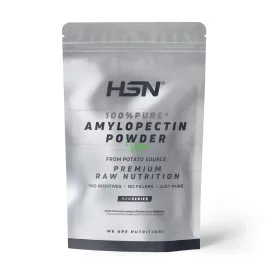
“Clean” carbs for your sports drink, no hassle
Evopectin (Potato Amylopectin) from SportSeries is a flavored carb-based food prep with sweetener.
Evopectin is amylopectin, sourced from potato, designed to mix easily into sports drinks. When you want to add carbs to your diet without turning your shaker into a “heavy shake,” texture makes all the difference.
Evopectin from HSN is practical, straightforward, and made for your daily training grind.
What amylopectin is and what makes it special
Amylopectin: a natural part of starch
Amylopectin is a fraction of starch naturally found in foods like cereals and tubers. Evopectin is extracted from potato starch, modified to isolate its amylopectin fraction.
From potato and in a flavored version
In this formula, potato starch is processed to extract a high-purity amylopectin fraction, keeping the product’s focus: complex carbs, no sugars.
Think of Evopectin as a handy way to add complex carbs to a drink, with a lighter texture than most other starches, making it perfect as a light post-workout or between-meals option.
Why pick Evopectin over other carbs
Complex carbs, zero sugars
If you want to add carbs to your diet without feeling heavy or spiking sugar intake, Evopectin is your best bet: a starch-focused profile (amylopectin) with 0% sugars.
Light texture, ideal complex carbs for drinking
One of Evopectin’s key perks is how it behaves in the shaker: it barely affects density, helping create lighter, easier-to-drink, and more enjoyable beverages compared to other low glycemic index complex carb options.
Delicious flavors, you choose your favorite
There are options for every taste, designed so the amylopectin doesn’t feel like “raw starch” if taken alone, making it easier to include in your routine.
- Potato amylopectin as the only carb source.
- 0% sugars (starch-focused profile).
- Light texture in drinks.
- Gluten-free and vegan-friendly.
- With delicious and refreshing flavors.
Potato Evopectin vs Corn Evopectin
The raw material changes: potato vs corn
Potato Evopectin uses amylopectin from potato, while Evopectin 2.0 is made with amylopectin from corn starch. That’s the first big difference: the source.
Why do they show different carb percentages in the table?
Potato Evopectin shows carb content “as is” (including the powder’s natural moisture), while the corn version is presented on a dry basis. That’s why you’ll see different numbers in the table even though the actual carb content is equivalent when measured the same way. Don’t choose one over the other based on this—they’re nutritionally equivalent.
Who Evopectin is for
If you want to up your carb intake without sugary drinks
A choice for those who prefer a complex carb powder, sugar-free, with a lighter texture than flours or cereal creams.
If you struggle to “eat more” during bulking phases
When adding carbs practically is key, a light drink can be the easiest way to include them without overthinking or feeling too full.
If you prioritize vegan and gluten-free options
Thanks to its source and formula, Evopectin fits vegan diets and is a gluten-free alternative.
Usage tips: how to use it easily
In your peri-workout drink
The most common way is mixing it with water in a shaker or bottle, adjusting the amount to your plan and what you already get from food. You can use it before, during, or after training, depending on how you organize your day.
Recommended combos
For a complete sports drink
Questions about Evopectin
Is it a 0% sugar product?
Yes. Evopectin contains no sugars; its amylopectin raw material is 100% complex carbohydrate.
Is there an unflavored version?
Why do I sometimes feel like I need to shake before drinking?
It’s normal for starch-based drinks to “settle” over time. Shake again before drinking to keep the texture even if you’re sipping slowly.
Is it a complex carb suitable for celiacs?
Yes. Evopectin, coming from potato, is a gluten-free complex carb option.
Is it better than the corn option?
Functionally, both are equivalent. Anecdotally, some athletes prefer one or the other based on how they feel. We recommend trying both and picking your favorite.
Scientific bibliography
- Copeland, L., Blazek, J., Salman, H., & Tang, M. C. (2009). Form and functionality of starch. Food Hydrocolloids, 23(6), 1527–1534.
- Tester, R. F., Karkalas, J., & Qi, X. (2004). Starch—composition, fine structure and architecture. Journal of Cereal Science, 39(2), 151–165.
- Jeukendrup, A. E. (2004). Carbohydrate intake during exercise and performance. Nutrition, 20(7–8), 669–677.
- Burke, L. M., Hawley, J. A., Wong, S. H. S., & Jeukendrup, A. E. (2011). Carbohydrates for training and competition. Journal of Sports Sciences, 29(S1), S17–S27.