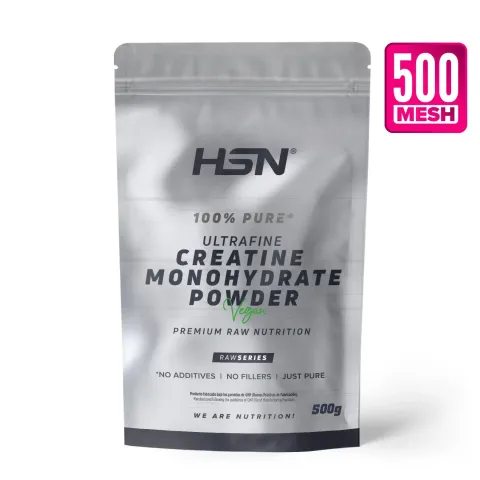
Ultrafine creatine to mix without “feeling it”
Ultrafine creatine monohydrate powder (500 Mesh) from RawSeries is a dietary supplement based on creatine monohydrate.
100% creatine monohydrate with an ultra-fine grind, designed for those looking for a creatine that mixes better and feels less gritty in the mouth. If you’ve tried creatine and what put you off the most was the texture, this version tackles exactly that: less sandy feeling, better integration, and more options to use it in both drinks and foods.
The classic creatine, with a much smoother mixing experience. Enjoy it only at HSN - the revolution has arrived!
What creatine is and why it’s been a staple in sports for decades
Creatine is a “base” compound in your energy systems
Creatine is a compound naturally present in the body. In muscle, part of it converts into phosphocreatine, which acts as a quick reserve to help regenerate ATP, the energy currency of effort.
Why it fits especially well for short, intense efforts
In short sets, sprints, heavy reps, or pace changes, the phosphagen system plays a starring role. That’s why creatine has become one of the most used dietary supplements when the goal is to perform.
- Creatine improves physical performance in successive sets of brief, high-intensity exercise. The beneficial effect is achieved with a daily intake of 3 g of creatine.
An ingredient with a track record among athletes
Creatine isn’t a recent fad: its modern use in sports became popular in the 90s, and since then it’s been researched in all kinds of athletes, from recreational populations to elite competitors.
Creatine and the gym
- Daily creatine intake can enhance the effect of resistance training on muscle strength in adults over 55 years old. This statement is aimed at adults over 55 who regularly do resistance training. The beneficial effect is obtained with a daily intake of 3 g of creatine combined with resistance training, which allows an increase in workload over time and should be performed at least three times per week for several weeks, at an intensity of at least 65%-75% of one repetition maximum load.
The key with creatine is understanding it’s an ingredient backed by huge research, but it works best when there’s training behind it and it’s used consistently.
Why monohydrate is still the gold standard
It’s the most studied form
When comparing “types” of creatine, monohydrate is the starting point because it has the most scientific literature and is the most used in research protocols.
The reasonable doubt with “alternative” forms
It’s common to see options like HCl, esters, or other salts. The practical issue is they don’t have the same volume of scientific evidence as monohydrate, so it remains the usual reference in both research and sports practice.
Choosing simple is choosing better
We present a product made of 100% creatine monohydrate powder with no blends or added ingredients, something that helps you get exactly what you need: knowing exactly what you’re taking.
500 mesh: what changes when the powder is ultrafine
Less “grittiness” and a cleaner mouthfeel
The easiest difference to notice is that thanks to the finer grind we get a more homogeneous mix and a smoother mouthfeel, especially in water or cold drinks.
Better suspension in shakes and drinks
In practice, many people look for exactly this: when mixing creatine in a shaker, you don’t get that typical heavy sediment typical of traditional 200 mesh creatine. With ultrafine creatine, the experience is much nicer.
More versatility in foods
The biggest difference is noticed in preparations like yogurt, quark, porridge, or creams (for example, rice cream). For example, if you mix regular creatine with yogurt, you can “chew” it, while this 500 mesh option goes unnoticed because it’s ultrafine.
100% pure: one ingredient, no additives
No proprietary blends or “fillers”
When it comes to creatine, the most valuable thing is exactly what’s not there: no flavourings, no “proprietary matrices,” no added ingredients of any kind. Just 100% pure creatine monohydrate.
Flavourless so it doesn’t mess with your combos
If you’re a fan of coffee, chocolate, cinnamon, or vanilla proteins, a flavourless creatine helps you add it to your shakes without changing their taste. And in recipes, that’s even more noticeable.
Common protocols: the key is not to complicate, but to be consistent
Two common approaches
In research and practice, there are usually two ways to use creatine: a faster “loading” phase at the start, or a more gradual approach from day one. Practically, our recommendation is not to “load,” but to keep a steady daily intake without breaks.
Timing: better to think “habit” than “perfect moment”
For most people, the biggest factor affecting creatine use quality is consistency. Choosing a time of day that’s easy for you (with a meal, in a shake, in your yogurt) usually beats chasing the ideal timing and forgetting after a week.
Who this creatine is for
If the texture in your mouth bothers you
If creatine is tough for you because of the gritty feeling it can cause, here’s an option designed to minimize that.
If you want to use it daily in shakes
A creatine that mixes better is easier to keep in your routine, especially if you don’t take it just with water.
If you like cooking and adding it to recipes
Yogurt, creams, porridge, bowls… when the powder is less noticeable, it’s easier for the recipe to keep tasting like it should.
Athletes under testing: a 100% safe creatine
The sensitive point: cross-contamination
In the real world, a common concern isn’t creatine itself, but the quality of the process: that a product doesn’t have “surprises” from cross-contamination or bad practices.
What it means that HSN “guarantees purity”
For those competing or under testing, choosing products that guarantee the absence of unwanted compounds is a way to ensure quality and peace of mind for athletes.
Our approach: clarity and control
In our products, we keep it simple: this creatine is 100% pure monohydrate, ideal for athletes seeking quality and safety in their dietary supplements.
What you can expect from taking creatine
Creatine is linked to better performance in brief, intense efforts and better work quality when repeating demanding sets. It’s not “instant energy”: it’s more of support for the muscle’s energy system, which happens after several weeks of daily use.
Myths that keep coming back
If you’ve read everything (water retention, hair loss, etc.), don’t worry. The key is to separate false myths from scientific evidence and stick with what’s well researched. Creatine is safe and has no adverse effects associated in healthy people at recommended daily doses.
Frequently asked questions (Q&A)
Why does this creatine feel less noticeable when taken?
Mainly because of particle size: a finer grind integrates better, leaving less gritty feeling, especially in cold drinks (that means 500 mesh).
Can it be taken on rest days too?
Yes, it should be taken on non-training days, it needs to be kept daily for routine and consistency, which is usually the most practical.
Is a “loading phase” necessary?
No, although it’s a strategy that appears in many protocols. In practice, the most important thing is that you can maintain the daily habit, consistently, without skipping doses.
Is creatine a pre-workout?
No. It doesn’t work like caffeine: its role is linked to phosphocreatine availability and performance in brief, high-intensity efforts. You can even take it at night without problems.
Does creatine cause hair loss?
It’s a common concern. Scientific evidence shows there are studies that specifically evaluated hormonal variables and hair follicle health without finding effects attributable to creatine. So it’s considered a totally safe option for men’s hair health.
Quick ideas to make the most of the 500 mesh version
Mix with yogurt/quark + flavouring
Mix well with a spoon and add: HSN flavouring and toppings (fruit, cinnamon, cocoa).
Rice cream, oats or porridge
Add it at the end, when you already have the texture you like. This way you adjust easily and avoid lumps.
Classic shake
In a shaker: liquid first, then the rest. Shake vigorously and enjoy your protein shake and creatine with a smoother texture.
Summary to decide in 30 seconds
- If you want monohydrate (the most studied form), here it is in 100% pure version.
- If the grit of traditional creatine bothers you, the 500 mesh format is designed for a smoother experience.
- If you want to use it in recipes, this ultrafine texture is better since it’s less noticeable.
- If you compete, you’re looking at a safe creatine with quality controls that guarantee you won’t have any issues from its use.
Bibliographic references
- Kreider, R. B., Kalman, D. S., Antonio, J., Ziegenfuss, T. N., Wildman, R., Collins, R., Candow, D. G., Kleiner, S. M., Almada, A. L., & Lopez, H. L. (2017). International Society of Sports Nutrition position stand: Safety and efficacy of creatine supplementation in exercise, sport, and medicine. Journal of the International Society of Sports Nutrition, 14, 18.
- Greenhaff, P. L. (1997). The nutritional biochemistry of creatine. The Journal of Nutritional Biochemistry, 8(11), 610–618.
- Harris, R. C., Söderlund, K., & Hultman, E. (1992). Elevation of creatine in resting and exercised muscle of normal subjects by creatine supplementation. Clinical Science, 83(3), 367–374.
- Candow, D. G., Forbes, S. C., Gualano, B., Jagim, A. R., Kreider, R. B., Rawson, E. S., Smith-Ryan, A. E., VanDusseldorp, T. A., Willoughby, D. S., & Ziegenfuss, T. N. (2021). Common questions and misconceptions about creatine supplementation: What does the scientific evidence really show? Journal of the International Society of Sports Nutrition, 18, 13.
- Liu, S., Huang, N., Wu, W., OuYang, X., Luo, Y., Zhong, Y., Wang, M., & Xiao, L. (2025). The impact of creatine supplementation associated with resistance training on muscular strength and lean tissue mass in the aged: A systematic review and meta-analysis. European Review of Aging and Physical Activity, 22, 26.
- Kreider, R. B., Gonzalez, D. E., Hines, K., Gil, A., & Bonilla, D. A. (2025). Safety of creatine supplementation: analysis of the prevalence of reported side effects in clinical trials and adverse event reports. Journal of the International Society of Sports Nutrition, 22(Suppl 1), 2488937.
- Lak, M., Forbes, S. C., Ashtary-Larky, D., Dadkhahfar, S., Robati, R. M., Nezakati, F., Khajevandi, M., Naseri, S., Gerafiani, A., Haghighat, N., Antonio, J., & Tinsley, G. M. (2025). Does creatine cause hair loss? A 12-week randomized controlled trial. Journal of the International Society of Sports Nutrition, 22(Suppl 1), 2495229.

 Delivery in 3-5 working days