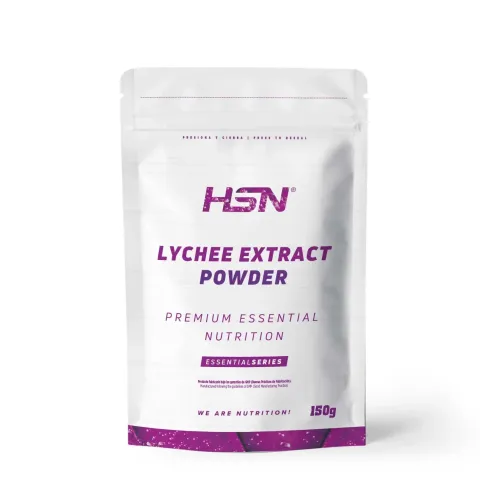
- Authentic lychee powder concentrate: Extract 10 times more concentrated from lychee fruit.
- 100% pure: Powdered extract with no additives or fillers.
- Broad-spectrum extract: Unstandardized, with its natural native composition of constituents.
- Totally diet-friendly: Suitable for vegan diets, allergen-free, GMO-free.
- Boost your recipes! Add lychee powder to your dishes for an extra nutrient kick.
Lychee powder - 10:1 extract
Lychee extract (10:1) powder from EssentialSeries is a powdered food supplement made from lychee.
Lychee, or litchi, is a tree from the Sapindaceae family, the only member of its genus, native to China and has gained international popularity for the ornamental look of the tree itself and for the culinary use of its fruit, which has juicy flesh packed with nutrients.
The benefits of lychee fruit packed with high potency into this extract.
Lychee in your diet, how to use the extract?
What is lychee?
Lychee is an Asian plant, native to China, widely cultivated in India, Australia, Israel, and Mexico; with an estimated global production of about 2,1 million tons per year.
Besides its decorative use, which is very popular in Asian countries, lychee is famous for its fruit’s characteristics. Lychee fruits have great economic importance due to their attractive red color, sweet and juicy pulp, and high content of bioactive compounds.
Nutritional features of the native fruit
The native lychee fruit is an excellent source of nutrients like polysaccharides, vitamins, polyphenols (flavonoids, terpenes, phenols, and flavan-3-ol molecules), and minerals.
It contains a high water content in its pulp; plus carbohydrates, fats, proteins, amino acids, phenols, pectin, minerals, and vitamins (Pareek, 2016). According to Anjum et al. (2017), lychee fruit contains several important fatty acids, including linoleic acid and myristic acid; and amino acids like lysine, tryptophan, and methionine. Kilari and Putta (2016) analyzed and concluded that lychee contains up to 72 mg of vitamin C per 100 g, which is a significant contribution to the recommended daily intake of this vitamin.
Key composition of the extract
The extract is best known for harnessing micronutritional and bioactive properties, leaving aside the macronutritional contribution of the fruit, so avoiding significant calorie intake, consumers can benefit from its active compounds.
Since lychee is such a diverse fruit with characteristic phytochemical constituents, we considered it inappropriate to standardize it to specific compounds, excluding others. That’s why our high-quality extract is not standardized to a particular compound but is considered a 'broad spectrum' option with its characteristic and varied native composition intact.
Enjoy lychee’s properties in a concentrated form.
Where to use it - how to include it in your diet?
Lychee powder extract, besides its nutritional features, adds flavor and culinary interest to recipes and preparations.
The most classic and traditional way to use it is simply by adding it to a glass of water to easily and directly enjoy the nutritional benefits of lychee extract.
However, the most interesting use is adding it to fruit shakes like juices or smoothies, energy bowls with granola, fruits, and seeds, or more elaborate recipes like mousses or protein-rich foams. Lychee extract retains part of the fruit’s natural flavor, resulting in a fruity taste with floral and slightly citrus notes and a sweet background. Due to its high extraction level, astringent aftertaste can be easily noticed when used, also because of the high concentration of native polyphenols from the fruit.
Mix it with other extracts for extra power!
One of the most common and promising combos with lychee extract is with acerola powder extract. Use them together in your recipes and get amazed by their benefits.
Bibliographic references
- Anjum, J., Lone, R., & Wani, K. A. (2017). Lychee (Litchi chinensis): Biochemistry, panacea, and nutritional value. In M. Kumar, V. Kumar, N. Bhalla-Sarin, & A. Varma (Eds.), Lychee Disease Management (pp. 237–256).
- Kilari, E. K., & Putta, S. (2016). Biological and phytopharmacological descriptions of litchi chinensis. Pharmacognosy Reviews, 10(19), 60–65.
- Koul, B., & Singh, J. (2017, March). Lychee biology and biotechnology. The Lychee Biotechnology, pp. 137–192.
- Schoch, C. L., Ciufo, S., Domrachev, M., Hotton, C. L., Kannan, S., Khovanskaya, R., … Karsch-Mizrachi, I. (2020). NCBI Taxonomy: A comprehensive update on curation, resources and tools. Database, 2020.
- Olvera, G. C., Cortes, J. S., Valdes, J. A. A., Paz, J. E. W., Pérez, O. B. Á., Flores-López, M. L., & Aguilar, C. N. (2025). Litchi chinensis: nutritional, functional, and nutraceutical properties. Food Production, Processing and Nutrition, 7(3), 1–20.
- Pareek, S. (2015). Nutritional and Biochemical Composition of Lychee (Litchi chinensis Sonn.) Cultivars. In M. S. J. Simmonds & V. R. Preedy (Eds.), Nutritional Composition of Fruit Cultivars (pp. 395–418).